Hastings ranked among England’s most deprived areas – but local communities are driving change
One neighbourhood to the northeast of the town was recently ranked as the seventh most deprived area in England.
High levels of deprivation in Hastings reflect a lack of affordable housing, limited job opportunities and poor transport links. These factors often contribute to poorer health outcomes, reduced wellbeing and shorter life expectancy. Our Tackling Poverty report highlights these issues, alongside the growing pressures of an aging population, disabilities, and the ongoing Cost of Living crisis.
However, behind the statistics lies a story of strength and community action. Hastings is home to many incredible local groups and charities working to improve lives, support neighbours and create opportunities. At Sussex Community Foundation, we’re proud to help fund and champion this work.
Through the Southern Water Goodwill Fund, more than £400,000 in grants has been awarded to 49 organisations in Hastings and St Leonards. These grants, several of them multi-year, are helping address the most pressing local needs. Grant decisions for this fund were guided by a local community panel, made up of people who live and work in the area. Their deep understanding of Hastings and St Leonards ensured funding has been awarded where it’s needed most, supporting projects that make a tangible, lasting difference.
Goodwill Fund for Hastings & St Leonards
The Goodwill Fund for Hastings and St Leonards at Sussex Community Foundation was a grants programme funded by Southern Water. Over £400,000 was given to support voluntary sector organisations, grassroots community groups, and established local charities that support people living in Hastings and St Leonards.
"Seeing the energy and commitment of communities in Hastings and St Leonards is truly uplifting. I’ve really enjoyed working with the community panel this year – their deep understanding of local priorities helped us make sure our grants reached the projects that will make the most difference."
Hannah Clay
-
Head of Grants and Impact at Sussex Community Foundation
The Dot Collective
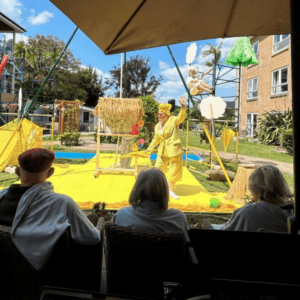
The Dot Collective provides accessible, professional theatre and creative activities for those living in care and with dementia. Their aim is to help reduce loneliness and social isolation, offering cognitive stimulation while at the same time uniting families and carers in a joyful and positive experience.
Thanks to a recent grant awarded by the Foundation, The Dot Collective brought two productions (a Christmas performance and another in the summer) to care homes and dementia groups in Bexhill, Hastings and Eastbourne.
Case study
A story from a beneficiary as told by a member of staff at the Dot Collective:
"At one of the care homes we performed at, we met a lady who was visiting her mum who suffered from dementia and had just moved in the week before. She told us that her mum used to be a drama teacher and an actress when she was younger. The mum seemed a little stressed before the show, but as the show went on she started to look more engaged, laughing and enjoying the performance with everyone else in the room. After the show, her daughter privately came to thank us.
She said: ‘It's been a really unpleasant time for all of us, with little joy. But today for the first time in ages my mum seemed like herself, more relaxed, and I was able to enjoy the time I spent with her. I just want to thank you for creating a morning of joy. My mum now has forgotten she doesn't like it here, and if the days can be filled with activities like yours, then I know she'll be okay.'"
This grant was awarded through our Improving Health funding priority, which supports those with physical and mental health needs, those who desire healthier lifestyles, and those who may live with life-limiting conditions or disabilities.
Surviving Christmas has been running for nearly 40 years, and through this time, one thing has remained constant: their passion for relieving hardship and distress for vulnerable people in Hastings and Rother during the festive period.
They provide more than just food or shelter; offering hope, dignity, and a reminder that people are cared for, especially at this time of year.
From 16 December, the charity began packing Christmas hampers, which will be distributed to families in need across the area. These hampers contain essentials to provide families with more than just a meal - they offer a sense of care and compassion at a time when they might feel forgotten.
“You are lovely people, angels from heaven to have brought me a food hamper at Christmas. Thank you.’
Hamper recipient
Christmas events
Surviving Christmas also have a Santa Day, open to every family who could not afford to take their children to see Santa. Children get presents and treats, and this year the added bonus of Rosie the Little Grey Pony!
On Christmas Day and Boxing Day, the charity provides traditional Christmas dinner and entertainment along with support services, including doctors, hairdressers and even an optician. They work to give people a Christmas to remember, which this year is more vital than ever after a difficult year for many because of the ongoing Cost of Living crisis.
“Thank you to you all, you have made my Christmas. My children will love their gifts.’
Hamper recipient
Surviving Christmas is more than just a charity - it’s a vital part of the community that brings people together to ensure everyone is supported. Their work reminds us all of the importance of looking out for one another and offering care and kindness, especially throughout the Christmas season.
Surviving Christmas received a grant of £5,000 towards providing their Christmas support. Find out more about the charity here. Read about more organisations we've supported here.
Community Grants Now Open for Hastings and St Leonards
Applications are now open for the Goodwill Fund for Hastings and St Leonards providing grants to support impactful local projects. Funded by Southern Water, over £400,000 is available for the area.
The funding criteria were developed in collaboration with a community panel of local representatives and youth groups, ensuring the grants address the most pressing needs of the Hastings and St Leonards communities. Managed by Sussex Community Foundation, the Fund focuses on our four key priorities: Tackling Poverty, Reaching Potential, Improving Health, and Acting on Climate.
“We’ve already distributed more than half a million pounds to businesses and events in Hastings and St Leonards, and are pleased to open the next round of grants to local charities and community groups.
We have worked closely with representatives of the local community panel and local youth groups, who have played a role in guiding the fund to respond to the needs for the Hastings and St Leonard community. The grant programme is supported by Sussex Community Foundation, which will further ensure the money makes a real difference to people in the area.”
Alex Willumsen, Southern Water’s Community Partnerships and Programme Manager
The grants are available to charities, community groups, community interest companies and community interest organisations working in the area.
“We are pleased to work with Southern Water on their Goodwill Fund, which will enable us to help charities and community groups right across Hastings and we encourage charities to come forward and apply for a grant.”
Kevin Richmond, CEO of Sussex Community Foundation
The deadline for the first round of applications is Friday 24 January 2025, with two further deadlines in the spring and summer.
To learn more about the application process and eligibility criteria, visit here.
Villiers Park Educational Trust
This charity is committed to improving the social mobility of less advantaged young people across the UK including Sussex. They believe every young person should have an equal opportunity to reach their potential at school, university and through their careers.
They deliver programmes that develop personal and employability skills and raise academic outcomes for young people aged 11-19 from under-represented backgrounds. A recent grant from the Foundation has helped fund their programme called 'Future Leaders' focusing on the areas around Hastings and Bexhill.
Their 'Future Leaders' coaching-led programme enables students to explore their education and career options. The programme is broken down in various elements, where students can explore their interests and then create, deliver and evaluate their projects. The programme also helps them develop key skills like teamwork, public speaking, & critical thinking.
A series of specialist workshops and courses allow students to explore potential career paths, experience university life. They also participate in sessions that increase their knowledge of their chosen pathway.
Talking about his participation to the programme, one of the students said:
“Cambridge University wouldn’t be on my radar without Villiers Park. Their programme has boosted my confidence massively and challenged me in helpful ways – by not making things easy, testing my limits. The practice interviews particularly made me realise I must prepare more. But rather than being scary, it’s productive. It has reduced anxiety because I know what to expect.”
The Reaching Potential report, the latest in the Sussex Uncovered series, highlights the challenges our county faces. It also emphasises the vital role local charities play in helping disadvantaged individuals reach their full potential.
"Without this programme I would be a lot less aspirational. I think it has made such a big difference it’s hard to put into words. They helped me look at life in a more holistic, authentic way - not just academic. Sometimes things happen that are beyond your control. Being able to respond positively to those changes is what matters. The biggest thing is breaking that wall between what I thought I needed to be like to do these"
A student attending the Future Leaders programme
Sussex Day 2024: Photo Competition winners
This Sussex Day, celebrated each year on 16 June, our first photo competition highlights the crucial work of local small charities and community groups. The four winning entries, one for each of Sussex Community Foundation’s funding priorities, will all receive £150 to support their work.
"Thanks for this fantastic news. We are really delighted that the panel loved our photo, we do too. It shows the Float and our work in full colour!"
Carrie Court, Sussex Green Living
The winners are:
Funding priority: Tackling Poverty
Winner - Horsham Matters
The charity provides services to support local people experiencing food and fuel poverty, including running the Horsham District Foodbank.
Funding priority: Improving Health
Winner - Soundcastle
Providing support for vulnerable communities across Sussex through transformational music programmes that increase confidence, enhance wellbeing and bring people together.
Funding priority: Reaching Potential
Education Futures Trust
This charity provides support and learning tailored to improve the life chances of vulnerable children and adults, particularly in Hastings.
Funding priority: Acting on Climate
Winner - Sussex Green Living
The charity engages and inspires Sussex people on green living through education and outreach activities, recycling initiatives and pop-up repair cafes.
“Sussex Day is a great opportunity to celebrate the best of our county and for us at the Foundation, that means our amazing network of small charities and community groups and the dedicated people behind them. We want to congratulate our four winners whose images show some of the incredible community and voluntary work making Sussex a better place to live for everyone.”
Kevin Richmond, CEO Sussex Community Foundation
Inspiring Hastings: Visits to Community Groups with the High Sheriff
Visiting groups is one of the most rewarding aspects of working at the Foundation and my day out with Lucinda Fraser, the new High Sheriff of East Sussex proved to be just that.
Lucinda Fraser and Philippa Gogarty, the High Sheriffs of both East and West Sussex respectively, have indicated that they want to work closely with us over the next year to highlight the work we are doing on Tackling Poverty. Since Hastings is a town that Lucinda knows well it felt like that would be a good place to start.
We began our day by meeting Tracy Dighton, the CEO of Citizens Advice 1066. Tracy gave us an overview of all the fabulous work being led by the voluntary sector within Hastings. She also gave us an insight into the labyrinth in her brain that allows her to keep track of all the projects and funding streams that she must juggle on an ongoing basis just to keep the organisation afloat. Lucinda, like many before her, had assumed that Citizens Advice offices are funded by the government when actually they are all independent charities.
After leaving Tracy, we walked up the road to meet Dave Perry, Chief Officer at the Seaview Project and Hannah Hallett the Business Manager. The Wellbeing Centre on Hathaway Road is a vibrant and friendly place where marginalised people with addiction problems and mental health issues can come together to use a range of support services. This was a truly humbling experience that left Lucinda and I feeling in awe of all the team working at the Centre.
Our final port of call was the Hastings and St Leonards Men’s Shed where we met Godfrey Bevan and some of his fellow trustees as well as some of the shed’s users. The level of skill displayed by the trustees and users was impressive but the best part of this visit was listening to the stories of the (mainly) men who use the facilities. They openly admitted that access to the shed was vital to their mental wellbeing and how without it, many of them would feel lonely and isolated.
"Hastings is home to some of the most deprived wards in the country and I anticipated ending the day feeling humbled and exhausted but what I wasn’t expecting was the overwhelming feeling of hope and optimism that met us wherever we went."
Jackie Wilkes, Philanthropy Manager
Spotlight on... Hastings
When we think about Sussex and the coastline, we picture summer holidays, fairgrounds and candy floss, fun games on the beach and sunny days. This may be the case for many holiday visitors, but the reality is there are multiple challenges facing the coastal communities here.
Our Tackling Poverty report highlights some of the issues these areas face, from an aging population and poor health and disabilities, to higher housing and living costs and limited job opportunities. The current Cost of Living crisis has only exacerbated the issue.
To explore this in more detail we are taking a focused look at the town of Hastings in East Sussex.
"The sense of community and resilience in Hastings is truly heartwarming. Despite the challenges highlighted in the report, it is uplifting to see dedicated staff and volunteers working tirelessly to create a more inclusive and supportive environment for all residents. The generosity of our donors and supporters is also vital to make a positive impact in the local community, and make Sussex a great place to live for everyone."
Kevin Richmond, CEO Sussex Community Foundation
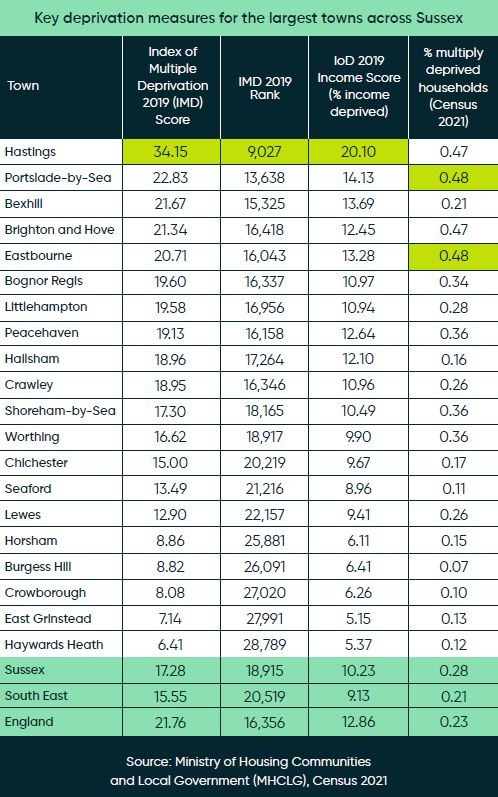
Hastings is top of the chart where income deprivation scores exceed the national average.
HASTINGS
Hastings has a rich history as a seaside town, attracting people from London and the South East when its ground-breaking pier was built in 1872. As piers fell out of fashion from the 1980s onwards the town’s tourist trade declined.
As highlighted in the report, Hastings is now one of the Sussex towns performing poorly across all seven key deprivation measures, which include income, employment, education and training, health and disability, crime, housing and living environment. The town has the highest multiple deprivation score (34.15) in the county and the highest percentage of income-deprived residents (20.1%).
An aging population
As one of the biggest towns in the South East, Hastings’ population has increased to just over 92,000 (Census 2021). 20.22% are over 65 with 15.3% of residents claiming Pension Credit, exceeding the national average of 11.3%.
Looking at changes in population there is a projected decline in Sussex of the 0-19 age group and Hastings has a much larger decline (-14.7%). Whilst the working age population is likely to remain static across Sussex, the proportion of those aged 15-64 in Hastings is expected to fall by a considerable amount (5.6%), which is, in turn, likely to have an impact on the labour market, with associated consequences.
Health & disability
One of the likely causes of the challenges faced by Hastings residents is linked to long-term health issues and poor outcomes for those with disabilities. Hastings has also the highest percentage of disabled individuals among all Local Authorities in Sussex (21.7% compared to 16.9% nationally). Additionally, it has the largest proportion of individuals with premature disabilities, as 14.7% of those under 65 are disabled under the Equality Act.
Unemployment and worklessness
Another reason for this high level of deprivation is linked to high levels of unemployment in the town. Hastings stands out with the highest percentage of individuals aged 18-24 claiming unemployment benefits (8.99%), which is more than twice the average in Sussex. The link with health and poverty is clear with 75% of all out-of-work benefits claimants and 69.1% of homeless households being people with health-related conditions.
SO WHAT'S HAPPENING ON THE GROUND?
At the Foundation we see and hear examples of the amazing work done by groups and charities in and around Hastings. Local organisations, like many of those we work with, are helping to tackle these challenges. Their dedication has a huge impact across our communities, offering support to residents struggling to make ends meet. From food and warmth, non critical debt advice and getting people off the street, these groups, very often small and local, are there for Hastings.
In this post we've highlighted some stories from charities and groups based in Hastings.
Hastings Advice and Representation Centre (HARC)
HARC offers specialist welfare benefit advice and representation. Their free and confidential service addresses inequalities, relieves poverty and improves the quality of life for vulnerable and disadvantaged people across the county.
Their community work is carried out at a range of venues and home visits, and provides support to some of the hardest to reach in the community. It effectively removes barriers imposed by homelessness, insecure housing, poor physical and mental health, lack of transport and social isolation.
“Family ‘C’ met with our advisor following a visit to the local foodbank. It was the start of multiple appointments which led to a payment and debt management plan. The support received has made a huge difference for the family: their income has been increased and debts are being managed. The pressure on their mental and physical health has been alleviated and the wellbeing and quality of life for the whole family has vastly improved.”
Member of staff at HARC
Education Futures Trust
Education Futures Trust provides high quality and innovative support and learning tailored to improve the life chances of vulnerable children and adults, particularly in Hastings.
The grant awarded by the Foundation enabled the group to set up a ‘warm space’ to offer their clients a refuge from the cold during the winter months. Warm drinks, snacks and hot meals were offered throughout the day, while skills-based activities would take place for those who wanted to be involved. The staff also offered advice, for example how to reduce the heating bills, or how to cook simple meals at home. Those attending used the 'warm space' to its full potential - to access hot food and drink, as well as to build social relationships.
“Those that use our services tell us that they are struggling. When attending our all-day courses, many come without food and try to hide this. When provided with donated pastries, they will often keep one to take home for ‘tea’. Those receiving our food hampers tell us that they only want food that can be eaten cold from the can; avoiding potatoes and items requiring heat or preparation.
We have learned that those we work with are going hungry and are cold. The choice between food and heat is no longer the challenge: many have neither.”
Member of staff at Education Futures Trust
Bags of Taste
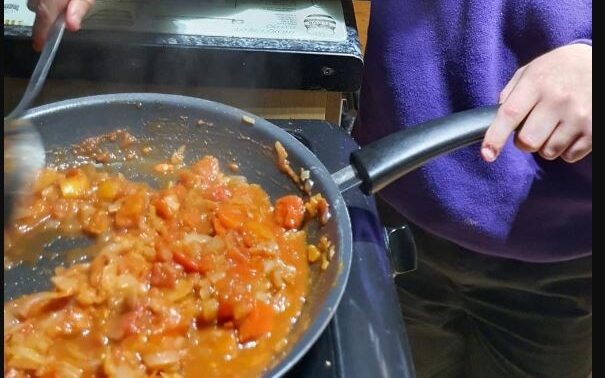
Bags of Taste supports vulnerable people in poverty in Hastings. Their Mentored Home Cooking courses are attended by those on a low income, who live in areas of high deprivation or are at risk of poor health outcomes.
One of the goals of the courses run by the group is to reduce health inequalities by encouraging individuals with limited budgets to prepare affordable and nutritious meals. Their initiative helps develop positive dietary habits, improved financial situations and overall wellbeing for the long term.
Their work is specifically focused on the most vulnerable in society, and they work closely with local referrers to identify beneficiaries. All attendees are disadvantaged by poverty and many have multiple and complex challenges, facing unemployment or suffering from mental health issues.
Since the start of the programme, the group has successfully delivered over 4,000 courses, reaching many residents suffering from mental and physical health illnesses or disabilities, as well as carers and single parents.
“I feel more confident about preparing food from scratch. I always used to think it was much harder than it actually was. This course has helped me realise that it’s not always more expensive to cook from scratch, and I can definitely make a saving in my food shop; buying in bulk helps us get us through the month.”
Course attendee
Our Tackling Poverty report highlights the desperate need in parts of Sussex, and offers insight and evidence of the need for more philanthropy, so we can make even more of a difference. The data and insights outlined in this report will also be a valuable resource for the voluntary sector in the county, providing crucial data to support funding applications to the Foundation and other funders.
Get in touch with the Philanthropy team to discuss how your donation can help make a difference in the Hastings area, Or you can donate directly to our Tackling Poverty Fund.
Lifesize CIC
Lifesize provides music and arts engagement for young people and adults living with challenges such as learning disabilities, mental health challenges, physical health conditions and dementia.
They offer a music, arts and wellbeing programme with sessions which includes singing and playing instruments. These sessions focused on alleviate feelings of anxiety, depression and isolation for the participants.
One of Lifesize’s volunteers writes: “We worked with one individual in several hospital settings over a number of weeks. She told us that the sessions had really helped her feel connected with people again and the music we chose to explore really relaxed her and helped alleviate anxiety. When the patient was discharged, she asked if there were similar group sin community settings.”
Education Futures Trust provides high quality support and learning tailored to improve the life chances of vulnerable children and adults, particularly in the Hastings area. Their work focuses on building resilience and improving health, especially mental health.
The grant given by the Foundation helped the group deliver a range of courses such as "Bushcraft" and "Women's DIY". The courses, aimed at vulnerable adults, were all based outdoors to highlight the benefits of being outside in contact with nature, and its impact on mental health and wellbeing.
The sessions consisted of a series of exciting, hands-on activities for adults suffering from poor mental health, especially those struggling with leaving their homes and being in unfamiliar places. All participants were encouraged to share their challenges and stories to support each other and develop a shared understanding that they were not alone.
Real Lives - Alice's Story*
Before attending the course, Alice showed a high level of social anxiety, she struggled to leave the house alone and would avoid busy areas. She reported that this started during the Covid pandemic, and had not significantly improved since. After a few attempts by a friend to involve Alice in Education Futures’ courses, she eventually agreed to attend ‘Women's DIY’, and a plan was made to support her to attend.
Initially, her friend walked Alice to the site where she would meet the course leader outside of the building. This was repeated each week. Alice was visibly anxious in the initial session and relied very heavily on the staff there. The following week, when the course leader met her outside, she mentioned that seeing others struggling like her made her feel less anxious, because they would understand and wouldn't think she was odd.
Alice's confidence grew, her participation increased during the course and she also started communicating with others. During a conversation with the course leader, Alice said that she 'wasn't quite there yet but felt better about going outside.'
Alice has attended other courses since then and is now able to attend and enter the building without any support from the staff. She now helps with her own DIY projects at home.